Shopify Development Cost in India (2026 Guide)
Shopify development quotes in India range from ₹15,000 to ₹5,00,000 for what looks like the same deliverable. Here's what's actually different at each price point — and what you actually need.
When Indian D2C brands start researching Shopify development, they typically encounter two confusing realities: the platform itself charges a monthly fee in USD, and the development quotes they receive range from a few thousand rupees to several lakhs for stores that appear superficially similar.
Both confusions are solvable once you understand what actually drives the cost.
What affects Shopify development cost in India
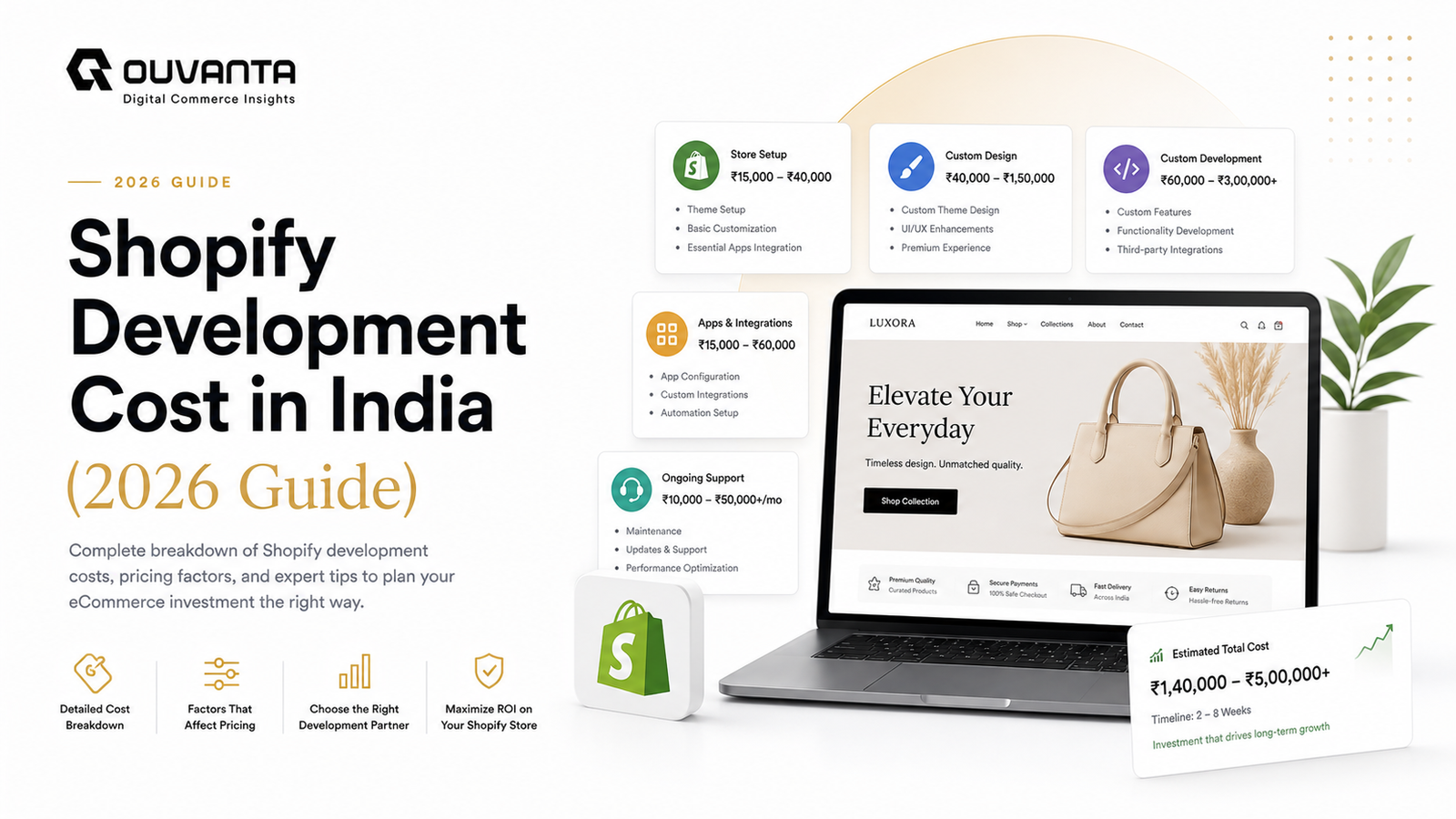
Theme vs custom build A Shopify store built on a premium theme (₹3,000–₹15,000 one-time cost) with your branding applied takes 1–3 weeks and costs ₹15,000–₹60,000 for development. A fully custom Shopify theme built from scratch takes 8–16 weeks and costs ₹1,50,000–₹5,00,000. Most brands don't need the latter. Number of products and variants A 50-product catalogue is straightforward. A 2,000-product catalogue with complex variants, filters, and inventory management is a significantly different project. Product data migration from another platform adds further scope. Custom features Standard Shopify handles most ecommerce scenarios. But custom subscription logic, B2B pricing tiers, custom bundle builders, complex discount rules, or integrations with ERP/inventory software require custom Shopify app development — which adds ₹50,000–₹2,00,000+ to project cost. Payment and logistics integrations Shopify Payments isn't available in India yet. Integrating Indian payment gateways (Razorpay, PayU, CCAvenue) and logistics partners (Shiprocket, Delhivery, EasyShip) is necessary and adds scope beyond a basic setup.
Cost breakdown by Shopify project type
Tier 1 — Basic setup on a premium theme What you get Premium theme configured with your branding, up to 100 products uploaded, Razorpay integration, basic GST setup, standard pages (home, collection, product, cart, checkout, about, contact). Typical cost ₹15,000 – ₹45,000 development + ₹3,000–₹15,000 theme cost Right for New D2C brands launching their first online store, businesses migrating from a basic website, brands that want to test ecommerce before investing more. Tier 2 — Customised theme with conversion optimisation What you get Premium theme significantly customised to match brand design system, conversion-optimised product pages, upsell/cross-sell logic, custom sections for brand storytelling, multiple payment gateways, logistics integration, GST invoicing, up to 500 products. Typical cost ₹60,000 – ₹1,50,000 Right for Established D2C brands investing seriously in ecommerce, businesses moving from WooCommerce or Magento, brands where AOV and conversion rate justify investment in UX. Tier 3 — Fully custom Shopify build What you get Bespoke theme built from scratch in Liquid, unique UX design system, custom Shopify app or metafield configurations, complex integrations, Shopify Plus features (custom checkout, scripts, B2B functionality). Typical cost ₹1,50,000 – ₹5,00,000+ Right for Scaling D2C brands with complex requirements, Shopify Plus merchants, businesses where differentiated UX is a competitive advantage.
Ongoing Shopify costs in India
The development cost is one-time. These are recurring:
Monthly Shopify costs (approximate INR at current rates) Basic plan ~₹1,700/month — suitable for new stores doing under ₹5L/month revenue Shopify plan ~₹4,500/month — suitable for growing stores, lower transaction fees Advanced plan ~₹18,000/month — for stores needing advanced reporting and lower transaction fees at scale Shopify Plus ~₹1,65,000/month — enterprise tier, justified above ~₹2Cr/month revenue Premium apps (reviews, email, subscriptions, etc.) ₹2,000 – ₹15,000/month depending on tools selected
Shopify charges transaction fees (0.5%–2% depending on plan) for orders processed through third-party payment gateways. Since Shopify Payments isn't available in India, all Indian Shopify stores pay these fees. Factor this into your margin calculations.
India-specific requirements that add scope
Several requirements are unique to Indian ecommerce and need to be budgeted specifically:
- GST invoice generation. Indian tax law requires GST-compliant invoices for B2B and often B2C transactions. Third-party apps like Avada Invoice or custom solutions handle this, but need configuration and testing.
- Cash on Delivery (COD). Despite the growth of UPI and cards, COD remains significant in many Indian categories. Enabling and managing COD on Shopify requires specific gateway and logistics integration.
- UPI and Indian payment methods. Razorpay and PayU both support UPI, credit cards, net banking, and EMI — essential for Indian shoppers. Basic Shopify setup doesn't include this; it needs specific integration.
- Logistics and shipping. Shiprocket, Delhivery, Blue Dart, and similar Indian logistics partners need API integration for real-time shipping rates and order tracking. This is not out-of-the-box Shopify functionality.
- Regional language support. If you're targeting customers who prefer Odia, Hindi, or regional languages, multi-language support adds development and translation scope.
When a premium theme is enough (and when it isn't)
Most Indian D2C brands launching their first Shopify store are better served by a well-configured premium theme than by a fully custom build. Here's why:
Premium themes from the Shopify Theme Store (Dawn, Impulse, Prestige, Turbo, Broadcast) are built by professional development teams, tested across thousands of stores, and optimised for conversion rate and performance out of the box. Configuring one takes a fraction of the time of a custom build and delivers results that are hard to distinguish for the shopper.
Custom builds make sense when:
- Your brand has a design system that genuinely can't be replicated in a theme
- You have complex product configuration or custom bundle mechanics that themes don't support
- You're on Shopify Plus and need custom checkout modifications
- You're migrating a large existing catalogue with complex data structures
For most new D2C brands, a custom build is a future consideration — not a launch requirement. If you're comparing Shopify to other platforms, our Shopify vs WooCommerce guide covers the trade-offs in detail.
Choosing a Shopify developer in India
What to check before hiring:
- Live Shopify stores to review. Visit their portfolio stores on your phone. Check loading speed. Evaluate the checkout flow. A portfolio that only shows desktop screenshots is hiding something.
- Understanding of Indian ecommerce requirements. Ask specifically about their experience with Indian payment gateways, COD, GST invoicing, and logistics integrations. These are non-trivial and a developer without this experience will be learning on your project.
- Post-launch support. Shopify stores need ongoing app updates, theme updates, and occasional bug fixes. Clarify support terms before launch.
- App recommendations. Ask which Shopify apps they recommend for your specific category — reviews, email marketing, loyalty, upsells. Their recommendations reveal category knowledge.
Our Shopify development service covers everything from initial store setup to full custom builds for Indian D2C brands, including all Indian payment, logistics, and compliance requirements. Book a free consultation to get a specific scope and cost estimate for your project.
Questions people ask
Development costs range from ₹15,000–₹45,000 for a basic theme setup to ₹1,50,000–₹5,00,000+ for a fully custom build. This is separate from Shopify's monthly subscription (₹1,700–₹18,000/month) and app costs. Most new D2C brands in India need the ₹40,000–₹1,00,000 range — a well-configured premium theme with Indian payment and logistics integration.
Yes. Shopify is fully available in India. However, Shopify Payments (Shopify's native payment gateway) is not yet available for Indian merchants, so all Indian Shopify stores use third-party gateways like Razorpay or PayU. This means Indian stores pay transaction fees of 0.5%–2% on orders depending on the Shopify plan.
A basic theme setup takes 1–3 weeks. A customised theme with Indian payment and logistics integration takes 4–8 weeks. A fully custom Shopify build takes 10–20 weeks. Timeline depends heavily on how quickly you can provide product data, brand assets, and content.
Shopify is generally the better choice for new D2C brands that want to focus on selling rather than managing technology. WooCommerce gives more control and has no monthly platform fee, but requires you to manage hosting, security, and maintenance. The total cost of ownership for WooCommerce is often higher than it appears once you factor in developer time and maintenance.
Yes — this is one of Shopify's strongest advantages over self-hosted platforms. Shopify's infrastructure is designed for traffic spikes and has handled multiple global sale events without downtime. Self-hosted WooCommerce stores frequently crash during peak traffic unless specifically provisioned for it, which adds cost and technical complexity.
Essential apps for Indian Shopify stores typically include: a payment gateway (Razorpay or PayU), a logistics integration (Shiprocket or similar), a GST invoice generator, a reviews app (Judge.me or Yotpo), and email marketing (Klaviyo or Omnisend). These typically add ₹3,000–₹8,000/month in recurring costs.
Share this article
If you want this done for you
Sources
Platform behaviour and thresholds referenced above come from the official documentation. Cost figures are drawn from live accounts in the Indian market and are stated as bands, not averages.
- Shopify plans and pricing — Shopify
- Transaction fees and payment providers — Shopify Help Centre
- Core Web Vitals — the thresholds and how they are measured — web.dev, Google