Meta Ads for Real Estate in India (2026 Guide)
Real estate is one of the highest-potential and highest-waste categories for Meta Ads in India. The difference between a campaign that generates 50 qualified enquiries a month and one that burns ₹80,000 with nothing to show is rarely the audience — it's the structure.
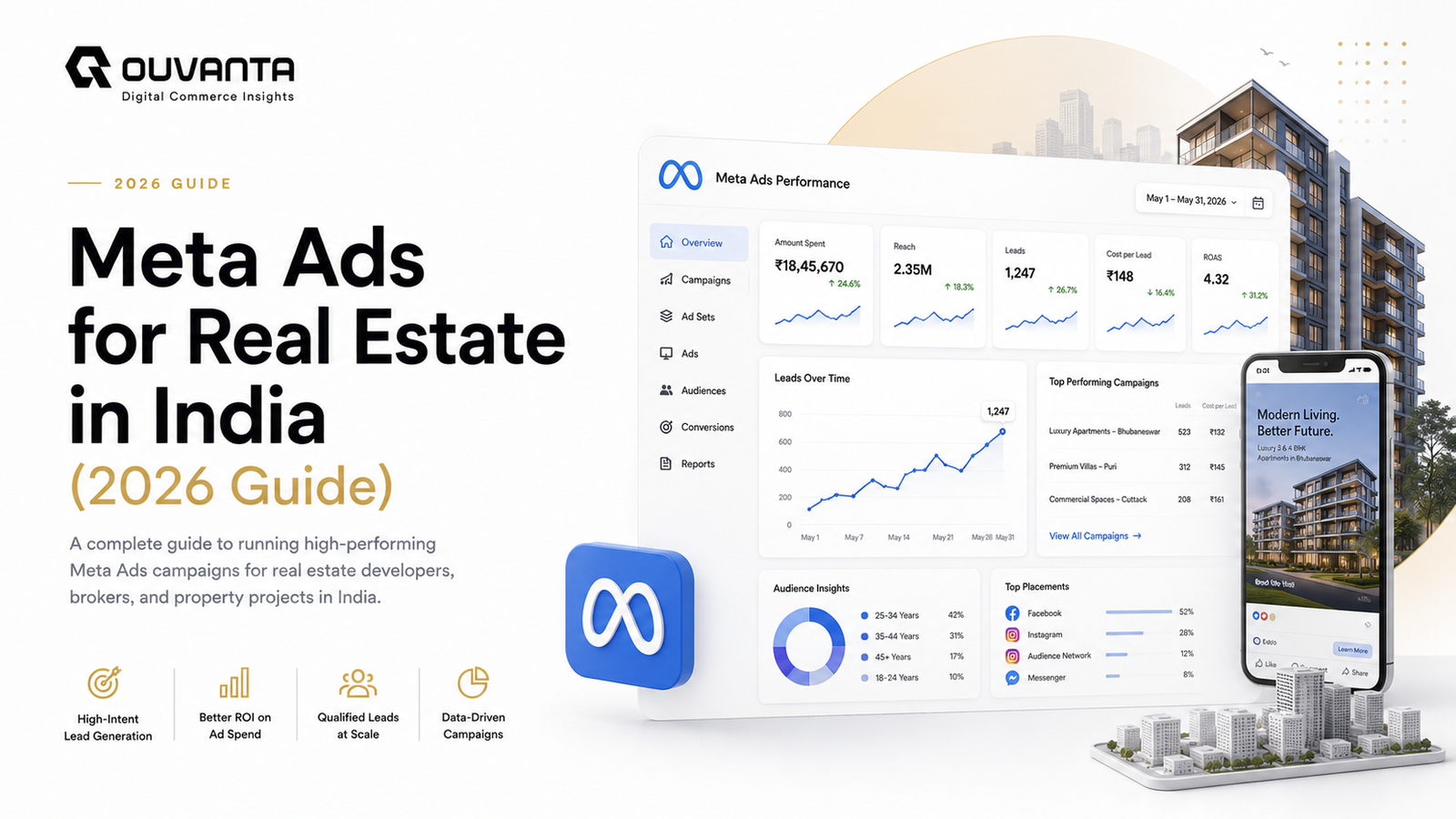
Real estate developers and brokers in India spend significant money on Meta Ads. Most of them are disappointed with the results — not because the platform doesn't work for real estate, but because the campaign approaches that work for other categories don't translate directly to high-consideration property decisions.
Buying a property is a months-long decision involving multiple stakeholders, significant financing, and high emotional weight. The Meta Ads funnel for this decision looks completely different from a campaign selling clothes or food delivery.
Why Meta Ads work for real estate (when done right)
India has over 350 million people on Facebook and Instagram. Property buyers are active on both platforms — researching locations, comparing projects, sharing options with family. The interest targeting available for property-adjacent categories (home improvement, interior design, investment, banking, construction) can identify early-stage buyers before they're actively searching Google.
This is Meta's advantage over Google for real estate: you can reach buyers who are thinking about buying but haven't yet typed a search query. Google captures demand that already exists. Meta can help create it — building awareness and intent for your project before the buyer is in active search mode.
The challenge: because these buyers are earlier in their decision process, the funnel is longer and lead quality is more variable. Optimising for this requires a different approach than most real estate campaigns use.
Campaign structure that generates results
The most effective real estate Meta Ads structure uses three layers:
Awareness (top of funnel) Video campaigns showing project walkthroughs, location benefits, and lifestyle imagery. Objective: Video Views or Reach. Budget: 20–25% of total. Goal: building familiarity with the project among the target geography before buyers enter active search mode. Consideration (middle of funnel) Lead generation campaigns targeting people who watched your awareness videos (30-second video viewers are a high-intent audience) and interest-based audiences. Objective: Lead Generation or Conversions. Budget: 50–60% of total. Goal: enquiries from warmed audiences. Retargeting (bottom of funnel) Campaigns targeting website visitors, people who opened but didn't submit your lead form, and past enquirers who haven't converted. Budget: 20–25% of total. Goal: lowest cost per qualified lead by re-engaging people who already showed intent.
Running only the middle layer — which is what most Indian real estate campaigns do — means you're spending on cold audiences with high cost per quality lead, while leaving the easiest conversions (retargeting) untouched.
Targeting real estate buyers on Meta
Effective targeting for Indian real estate varies by project type:
Targeting by property category Affordable housing (₹20L–₹50L) Age 25–40, income indicators (devices, behaviours), employed in specific sectors, geographic radius around property. First-home buyer intent signals. Home loan interest targeting. Mid-segment (₹50L–₹1.5Cr) Age 30–50, professionals, parents of school-age children (neighbourhood matters), upgrade buyers. Targeting should include people with existing home loan interest and investment property intent. Premium / luxury (₹1.5Cr+) Lookalike audiences from existing buyers are most effective. Interest targeting for luxury categories (premium brands, travel, investments). Geographic targeting of upscale neighbourhoods. Facebook's "High Net Worth" audience segments. Commercial / plots Business owners, entrepreneurs, SMB decision-makers. Investment intent signals. LinkedIn audience integration where business profile matters.
What creative actually converts for Indian real estate
Based on performance data across real estate Meta Ads accounts, certain creative formats consistently outperform others:
- Property walkthrough videos (60–90 seconds). Show the actual spaces — kitchen, bedrooms, bathrooms, amenities. Buyers need to visualise living there. Drone footage of the location and surroundings performs particularly well.
- Before/after interior visualisations. Show the raw flat and the furnished version side by side. This answers the most common mental question: "What could this actually look like?"
- Location advantage carousels. Multiple images showing proximity to schools, metro stations, hospitals, and commercial areas with actual distances. In Indian real estate decisions, location context is often the deciding factor.
- Offer and pricing ads. Direct "Pre-launch price: ₹X per sq ft" ads to warm audiences perform well when the price is genuinely competitive. Don't lead with this to cold audiences — it cheapens the positioning before trust is established.
What doesn't work: Generic "luxury living" stock photo ads with vague headlines ("Your dream home awaits"). These look identical to every other real estate ad, generate low-quality curiosity clicks, and produce poor lead quality.
Lead quality vs lead volume
Real estate developers often optimise for CPL (cost per lead) and are happy when they see 300 leads per month at ₹200 each. But if 5% of those leads answer the phone and 1% convert, that's 3 sales from ₹60,000 in ad spend — and the sales team is burning time chasing 285 people who will never buy.
Higher-quality leads, even at ₹800–₹1,200 each, often produce better ROI because they close at higher rates and require less follow-up effort.
To improve lead quality:
- Use Instant Forms with "higher intent" setting rather than "more volume" — this adds a review screen before submission, filtering casual clickers
- Add qualifying questions to your lead form: "What's your preferred budget range?" "Are you planning to buy in the next 3 months, 3–6 months, or 6–12 months?"
- Target narrower, more specific audiences rather than mass audiences
- Track which lead sources actually result in site visits and bookings, then optimise backward from that
Cost benchmarks for real estate Meta Ads in India
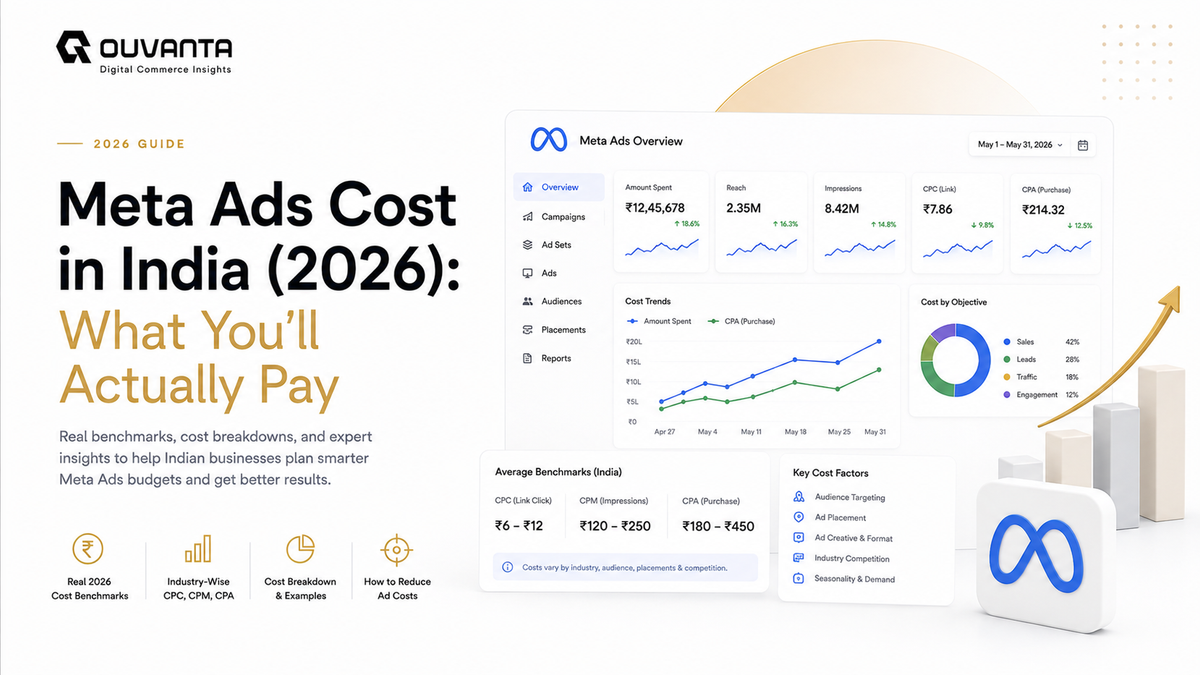
Typical CPL ranges (Meta Ads, India) Tier 1 cities (Mumbai, Delhi, Bangalore) ₹600 – ₹2,000+ per lead. Higher competition, higher CPMs, higher property values. Tier 2 cities (Bhubaneswar, Pune, Jaipur, Kochi) ₹300 – ₹1,200 per lead. Less competition, better targeting efficiency. Tier 3 / emerging markets ₹150 – ₹600 per lead. Lower competition, but smaller total audience pool. Retargeting campaigns (any tier) 30–50% lower than cold audience campaigns for the same project.
For Bhubaneswar and Odisha real estate specifically, Meta Ads CPMs are significantly lower than metro cities. A well-targeted campaign here can generate qualified enquiries at costs that would be considered exceptional in Bangalore or Mumbai.
Common real estate Meta Ads mistakes in India
- Running only one ad set with no creative testing. Real estate creative fatigue happens fast — the same 50,000 people in Bhubaneswar seeing the same property ad for six weeks stops producing results. Rotate at least 3–5 creative variants per campaign.
- No follow-up system for Meta leads. Meta Lead Ads generate leads instantly — if your sales team doesn't call within 30 minutes, the lead goes cold. The quality of your follow-up system determines whether your Meta Ads "work" more than the campaigns themselves.
- Targeting too broadly during launch. "All people in Odisha aged 25–55" is not a real estate audience — it's most of Odisha. Start narrower, prove CPL, then expand.
- No pixel or tracking setup. Without proper Pixel implementation on your project website, you lose retargeting data and conversion optimisation capability. This is non-negotiable for serious real estate Meta Ads.
If you're running real estate campaigns and not seeing the results these benchmarks suggest are possible, the problem is almost always in one of the areas above. Our Meta Ads management includes a free account audit — book a review and we'll identify exactly where your campaigns are losing efficiency.
Understanding the broader cost landscape is useful context too — see our Meta Ads cost guide for India for CPM and CPC benchmarks across industries.
Questions people ask
Yes, when structured correctly. Meta Ads are particularly effective for building awareness among buyers in the research phase — before they're actively searching on Google. The key is running a full-funnel approach (awareness, consideration, retargeting) rather than only running direct lead generation campaigns to cold audiences.
Cost per lead ranges from ₹300–₹600 in Tier 2 cities like Bhubaneswar to ₹600–₹2,000+ in metro cities. Retargeting campaigns typically generate leads at 30–50% lower cost than cold audience campaigns. Lead quality (how many actually convert) matters more than raw CPL.
A meaningful minimum is ₹50,000–₹80,000/month in ad spend to gather enough data for algorithm optimisation and run proper full-funnel campaigns. Below this threshold, you're spread too thin across the funnel layers to see what's working. Management fees are separate.
Property walkthrough videos (60–90 seconds showing actual spaces), location advantage carousels showing proximity to key amenities, and before/after interior visualisations consistently outperform generic luxury lifestyle images. Show the actual property and the actual location — buyers need to visualise, not be inspired.
For volume and lower CPL, Facebook Lead Ads (native forms within Facebook) are more efficient. For lead quality, sending traffic to a detailed landing page with qualifying questions filters out low-intent enquiries. Many successful real estate campaigns use Lead Ads for cold audiences and landing pages for retargeting, where intent is already established.
New campaigns typically need 3–4 weeks to exit the learning phase and start delivering consistent results. The full funnel — awareness building followed by consideration and retargeting — takes 6–8 weeks to work properly. Expect the first month to be investment in data and audience building, with efficient lead generation from month two.
Share this article
If you want this done for you
Sources
Platform behaviour and thresholds referenced above come from the official documentation. Cost figures are drawn from live accounts in the Indian market and are stated as bands, not averages.
- About ad auctions and delivery — Meta Business Help Centre
- About the learning phase — Meta Business Help Centre